From our first drill manual to our latest reports, sharing knowledge has always been part of our mission.
We provide regular updates through our Newsletters and Annual Impact Reports to keep you informed and confident in the difference generosity makes.
This is where our stories live—from powerful personal journeys to valuable “Lessons Learned” along the way. It’s the place where we share the heart and soul of our mission. Visit often for the latest updates, inspiring stories, and behind-the-scenes insights.


Lifewater Canada has been featured in many publications over the years. To read an article by one of the sources featured below, click on the “News” filter in the section above!


An average well costs $5,500. Serving 600 people, this will last for eight years before any major repairs necessary. That translates to $688 per year. Each well provides water to about 600 people, so $688 provides water to about 600 people per year. That same well serving 300 people, who use the well as their primary water source, will last upwards of 12 years before a major repair, equaling a maximum of $458 per year or $1.52 per person per year.
We welcome the passion of those who have asked “What about Canada’s First Nations communities that don’t have safe drinking water?” It’s a very good question. The United Nations has stated safe drinking water is a basic human right, but not everyone in Canada or internationally has access to it.
At Lifewater, we focus on communities in parts of the world where governments lack funding and capacity, where there is limited access to basic technology such as drilling rigs, and where simple, cost-effective solutions like hand-powered pumps and rainwater catchment and storage systems are welcomed and can be affordably maintained by locals. Thus, the official “objects” that Lifewater has filed with the Canada Revenue Agency (CRA) say we will focus our safe water efforts in the developing world. Straying from those objects could cost us the right to issue tax receipts to our donors.
Meanwhile, safe drinking water continues to be a very pressing issue for many of Canada’s Indigenous communities, and yet our nation has the tools, expertise, and capacity to solve this. The solution lies in government leadership, political will, cooperation, and community ownership of the issues we face. Our government needs to understand that millions of Canadians care about safe water in our Indigenous communities. As citizens, we can — and should — speak out.
If you wish to support water projects benefiting Canada’s Indigenous people, please do some online research to identify your options. One is Water First, a Canadian organization providing internships that give Indigenous people the expertise to operate water treatment facilities. Water First also collaborates with Indigenous communities to protect water quality by restoring natural habitat.
Thousands of children and adults are dying every day because their drinking water is polluted. Each of them matters. There is no time to debate who should be responsible, or how we define the place we call “home.”
The number of wells and other water projects completed each year depends on the amount and timing of donations that we receive, plus drilling/construction challenges and reporting schedules. We occasionally run short of funds and need to wait for donations to come in to complete a project.
Another factor is the timing between project completion and when we receive the required documentation. For example, wells and communal washrooms may be completed in June but donor documentation isn’t completed until July. If mailing delays result in us receiving these documents after June 30, the project will be reported as “complete” in the next fiscal year. Delays caused by civil unrest, impassible roads during rainy season, and shortages of pump parts or key drilling supplies have all resulted in projects being reported in different fiscal years.
About 300 to 600 people usually draw water from each well, but the number for any specific well can be as low as 50 or as high as 1,000. To estimate this number, we observe the number of homes and talk to village elders. However, once a safe drinking water supply is established, people from surrounding communities may come to draw water.
We try to keep the number of people supplied by each pump to fewer than 300 to minimize wait times to draw water, and to reduce social disruption caused by crowds of women and children waiting to draw water (noise, littering, pump misuse, conflict potential over fee collection and water drawing times, etc.). Managing the number of people depending on any one well also maximizes the amount of time between required repairs since over-use will lead to more frequent breakdowns.
This is a very important issue, one that we continually work hard to address. The life-saving health benefits of a safe drinking water supply are lost if a pump breaks down and people revert to traditionally unsafe sources. We address this problem in several ways:
In 1994, Jim Gehrels, co-founder of Lifewater Canada, met a pastor from Liberia who said it was pointless to talk to people about the love of God when they are suffering and dying because they lack something as basic as safe drinking water. Jim was moved enough to use his training and experience as an Ontario government hydrogeologist to go to Liberia to help the pastor. God also inspired other people, putting a burden for West Africa on their hearts, and this has kept the program going and helped it expand over time.
We want to ensure that we stay effective, and it really helps that we know and understand African culture, people, climate, and geology. To ensure that donor dollars achieve the biggest “bang-for-the-buck,” we have maintained a focus on Liberia. We know that over 90% of our wells drilled there will find safe water within 25 metres below ground surface using the small, portable Lone Star drill rigs. This helps us keep our drilling costs down and enables us to help many villages in need. One of our guiding principles is “because the need is overwhelming, do the easy ones first.”
Over time, we have gradually expanded into other African countries (including Kenya and Nigeria) and into Haiti. As for adding more countries and more continents, logistics become much more complicated and expensive if we start to work in many places, and we are committed to keeping our overhead costs under 10%.
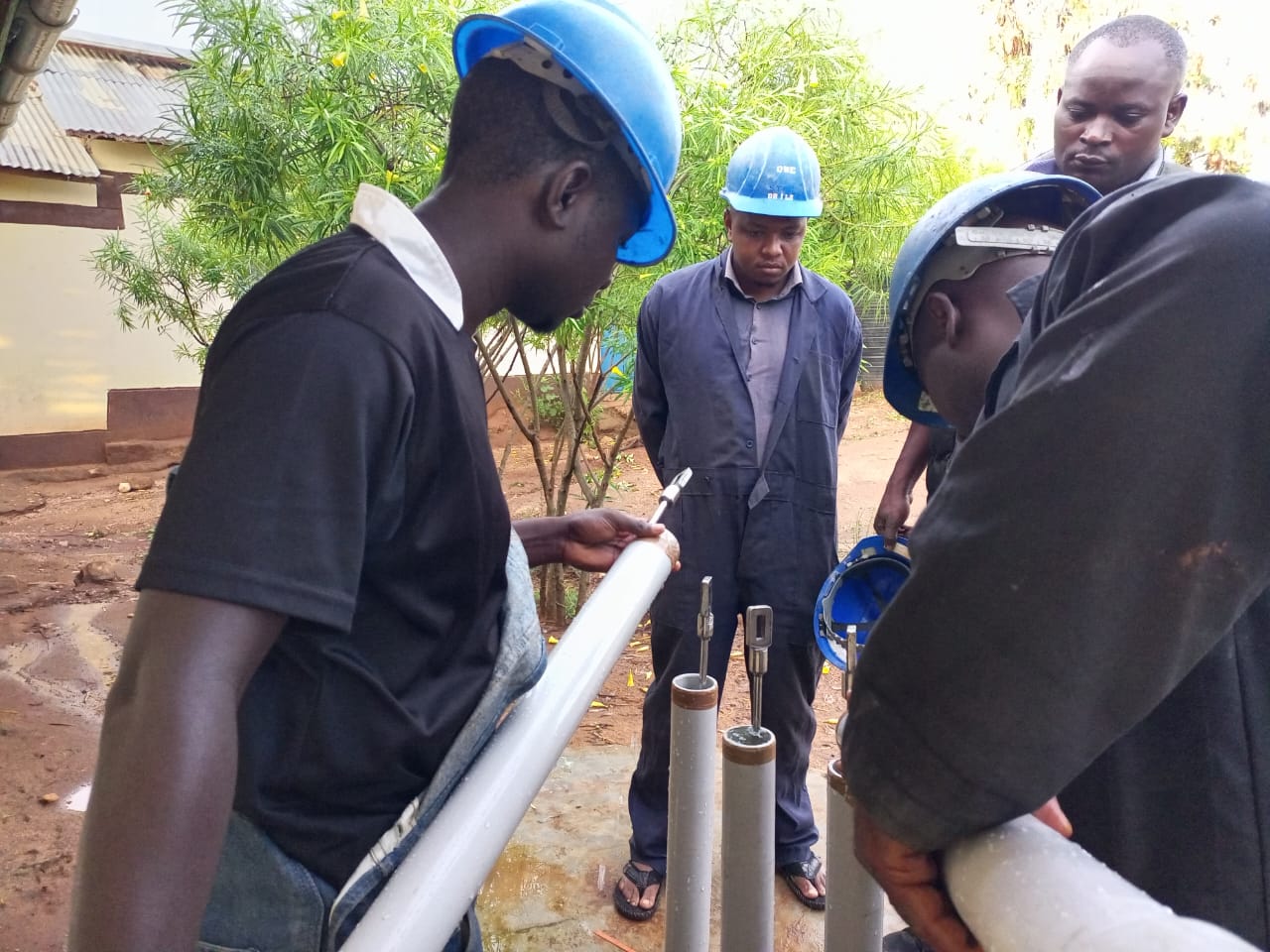
Normally once or twice a year, teams of volunteer professionals from North America travel overseas to providing advanced training to our drilling teams to improve their methods and efficiency. In recent years, our teams in African nations (Liberia, Kenya, and Nigeria) have acquired enough knowledge to begin visiting each other to provide valuable cross-training.
These sessions led by our North American volunteers and/or Africans cover a wide variety of topics including drilling techniques, logistics, and equipment maintenance. We also train our teams to visit villages before the wells are drilled to mobilize communities — teaching them about basic health and hygiene, getting the construction contracts signed, recruiting people to provide basic labor and materials, and helping them select a Well Caretaker.
We also focus on “clustering” projects and working closer to the teams’ home base to minimize travel times and increase efficiency. Finally, we have built or helped to build compounds in Liberia, Nigeria, Kenya, and Haiti so drilling and pump equipment and supplies can be bought in bulk and securely stockpiled to minimize time spent gathering items for each project.
Volunteers from Canada and the U.S. travel overseas to audit projects to ensure they are completed and providing value. We have project evaluation forms to quantify project benefits, but the forms are only as good as the data we can collect. Health data from medical clinics is often non-existent and we need to rely on infant death statistics as reported to us by villagers. There is clearly a pattern of significant health improvements after wells and latrines are built, but these are often difficult to objectively substantiate.
We have observed that the life-saving health benefits of a safe drinking water supply are lost if a pump breaks down and people revert to using traditionally unsafe sources. We are continuously developing ways to improve long-term maintenance and we charge villagers a small fee (in cash or “sweat equity”) for new wells so villagers have a sense of ownership.
This can be difficult when many large non-government organizations provide everything for free. However, we have learned that if villagers are not willing to contribute “up front,” they won’t contribute when the pump inevitably needs repairs.
We receive significant donations from families, schools, and church groups in the U.S., U.K., Netherlands, and Australia. In recent years, 10-15% of our revenue has come from international donors.
In addition, we receive contributions from the villages where we work. Village contributions are especially critical in terms of villagers taking ownership of their well project and not just sitting back and receiving a handout. These funds go directly to the local Lifewater crews to fund additional work and are not reflected in our financial statements.
Our work with our overseas partners is governed by two agreements that we maintain in a tailored manner with each partner, reviewed every fiscal year, and sometimes reviewed quarterly:
Yes. We welcome donations of Canadian and U.S securities. If you need assistance with the process, please email us (info@lifewater.ca).
We periodically ship supplies to Africa and Haiti, but because it is very expensive (up to $10/cubic foot or per pound), we ship only what is absolutely necessary — buying the rest locally to also help local economies. This typically includes drilling polymer, Little Beaver drill rig parts, mud pumps, and water testing supplies.
Lifewater Canada can drill wells for less cost than most organizations because we rely in Canada on staff and volunteers working from home. This keeps our annual overhead expenses below 10%.
Also, our overseas partners are staffed and run by local African people so we don’t need to pay to keep North American staff in the field. Finally, we are focused on drilling the easy wells first. Given the extreme need, it is our goal to put in as many wells in needy villages as possible. We use small, portable rigs that can quickly drill wells up to 100 feet deep in areas not underlain by hard rock.
We also have more robust rigs for drilling deeper in more challenging conditions. As a result of low overhead and targeted drilling using simple technology, our well cost is kept to around $5,000 – $6,000 (refer to our Project Costs page for up-to-date approximations).
Well sites are identified in two ways. Normally we allow our local workers to select drilling sites. They receive many requests and prioritize them according to need. In general, clinics, orphanages, and schools without safe water are our highest priority.
When we drill community wells, we engage villagers in selecting the site. It must be accessible to everyone — meaning not on private land. Sometimes we are contacted by people, non-profit groups, service clubs, or other organizations wishing to have a well drilled at a specific location. In this case, we charge the full cost of the well, with $500 being a non-refundable deposit with the remainder paid upon successful completion of the project.
We do not send money overseas until project work is completed and we have received the required documentation. This includes a copy of the well record, a thank-you letter from the village, and photos of the village and the completed well, pump replacement/repair, rainwater harvest and storage system, or new toilets.
In addition, every 12-24 months, we have volunteers from North America travel to Africa or Haiti to verify that work has been completed and that it is done well (we have never found any false reporting). After a well is finished and paid for by Lifewater, we look for a sponsor among donors that have expressed interest. When a sponsor is found, his/her name is added to our website.
We deliberately do not attach a plaque to the well with the sponsor’s name because we want the villagers to take ownership of the well.
Yes. Lifewater Canada respects individuals’ privacy and are committed to keeping personal information accurate, confidential, secure, and private. Details are summarized in our Privacy Policy.
Most wells are completed in five days. The actual drilling is often done in 1-2 days. However, it can take months in advance to ensure a village has received health and hygiene training, has raised required funds, and is mobilized to work.
In shallow African aquifers, bio-fouling and chemical precipitation may limit the life of some wells, but most should last decades or centuries! When wells stop being used, it is usually because users have moved away (such as a decommissioned refugee camp), handpumps break down (they need maintenance every 6 to 36 months), natural groundwater quality is unpleasant (high iron staining, sulfur rotten egg smells, etc.), or the wells were improperly constructed.
There are usually far more construction problems with wells that are dug by hand rather than drilled by machine. The problems include the wells being too shallow (so they empty during dry season) or having poor annular seals (surface contamination makes water unsafe to drink).
The Canada-U.S. tax treaty allows Lifewater to directly issue tax receipts to U.S. citizens, but the receipts can be used only to offset Canadian income. However, if you are a U.S. donor wanting a receipt but have no Canadian income to offset and intend to use the receipt for your U.S. filing to offset U.S. income, you can donate to Lifewater Canada through Friends of the Great Commission, a U.S.-registered charity that can collect donations on our behalf and issue U.S. receipts for donations by U.S. citizens. Go to Friends of the Great Commission.
Overseas trips occur once or twice a year and involve small groups of volunteers (3-6 people). Our focus is on helping train and equip the local community to care for themselves. While a few repeat donors are welcome on each trip, most spots on the team are reserved for volunteers with professional expertise in subject areas for which local workers are seeking more training. Volunteers wishing to travel overseas should consider the following facts: